
Trust is not governance
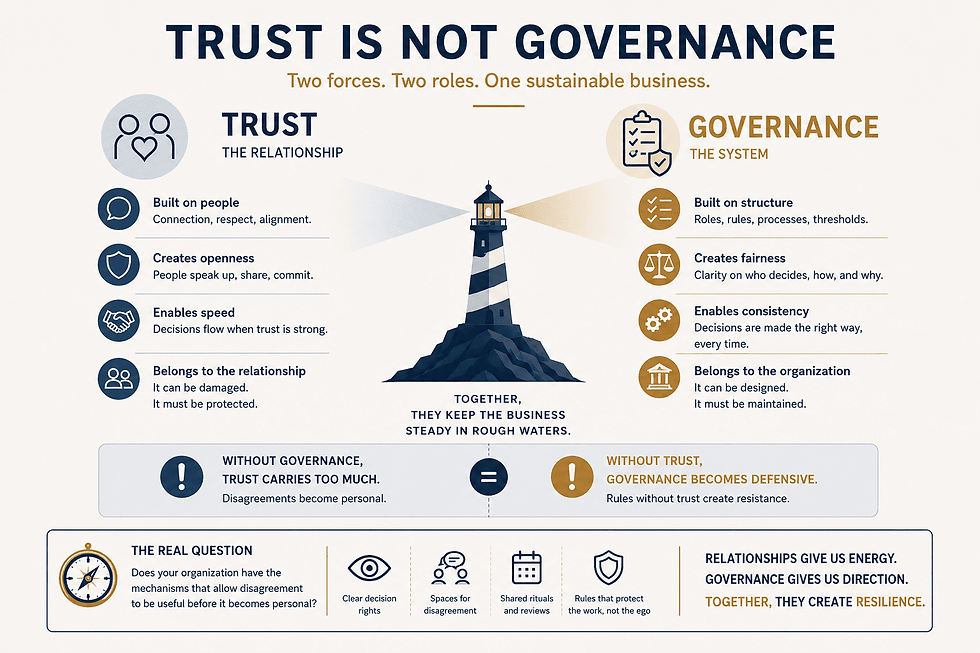
In many growing companies, this distinction appears late. Often after a difficult decision, a disagreement between partners, a senior hire that does not work as expected, or a strategic tension that everyone tried to handle through goodwill.
At first, the relationship carries everything. People trust each other. They speak directly. They move fast. They do not feel the need to formalize every decision, every role, every boundary.
And for a while, that works. Until pressure changes the weight of the relationship.
- A cash tension appears.
- A client becomes too important.
- A recruitment decision divides the leadership team.
- A margin problem forces uncomfortable trade-offs.
- Someone disagrees, but the disagreement has no proper place to exist.
So it becomes personal.
A governance issue starts to sound like a loyalty issue. A strategic concern is heard as a lack of trust. A request for clarity feels like control. A necessary objection becomes emotionally expensive. This is where trust is asked to carry what only structure can carry.
Governance is not the opposite of trust. Good governance protects trust from being overloaded. It creates places where disagreement can be expressed without threatening the relationship. It clarifies who decides, on what basis, with which information, and how conflicts are handled when interests, risks or time horizons diverge.
In a small or mid-sized company, governance does not always need to look heavy. It can be as simple as clear decision rights, documented arbitration rules, regular financial reviews, explicit thresholds for commitments, or a shared understanding of which topics require collective validation.
The issue is not bureaucracy. The issue is whether the company can hold pressure without turning every disagreement into a relational test.
When governance is weak, the signs are rarely dramatic at first. Meetings remain polite, but decisions are reopened afterwards. People agree in the room, then call each other separately. Sensitive topics are postponed because “now is not the right time”. The founder keeps the final say on paper, but not always in practice.
Partners avoid naming what they no longer see the same way.
The company still says, “we trust each other”, but the structure no longer helps that trust survive complexity.
Trust belongs to the relationship. Governance belongs to the system. A mature company needs both. Because under pressure, trust without structure often becomes fragile. And structure without trust becomes defensive.
The real question is not whether people trust each other. The question is whether the organization has built the mechanisms that allow disagreement to remain useful before it becomes personal.
©S.O.L. Consulting
Commentaires